Reading a tip: the audited decrypt
A tip’s content stays sealed until an operator opens it. The moment you open it, TypVault decrypts it for you. That open is a disclosure event: it gets a row in the audit log, and that row cannot be changed or removed.
This is not a warning. It is how the system is built to work, and it is the same posture whether you are looking at your first tip of the day or your fiftieth.
What counts as an open
Section titled “What counts as an open”Each of the following decrypts content on your behalf, and each is logged the same way:
- Opening a tip’s narrative and details.
- Opening its message thread with the reporter.
- Viewing its location on the map.
- Printing it.
- Running an AI read on it, or a similarity check against other tips.
If a tip moves to or from another program, the decrypt needed to prepare that move is logged the same way, too.
What the log records
Section titled “What the log records”Every disclosure row holds three things:
- Who: the operator who opened it.
- When: the exact time of the open.
- Why: which of the actions above triggered it.
The row is written first, before the decrypt is even attempted. A failed open still leaves a trace.
Viewing a tip’s audit trail
Section titled “Viewing a tip’s audit trail”- Open the tip.
- Open its audit view.
- You’ll see the deliberate actions taken on the case, newest first.
- Turn on the option to show every open if you need the full disclosure history, not just the workflow actions.
- If a tip has more history than fits on screen, the trail says so rather than showing a partial list as if it were complete.
Some roles do not carry access to a tip’s full audit view. If yours doesn’t, your program admin can check your access.
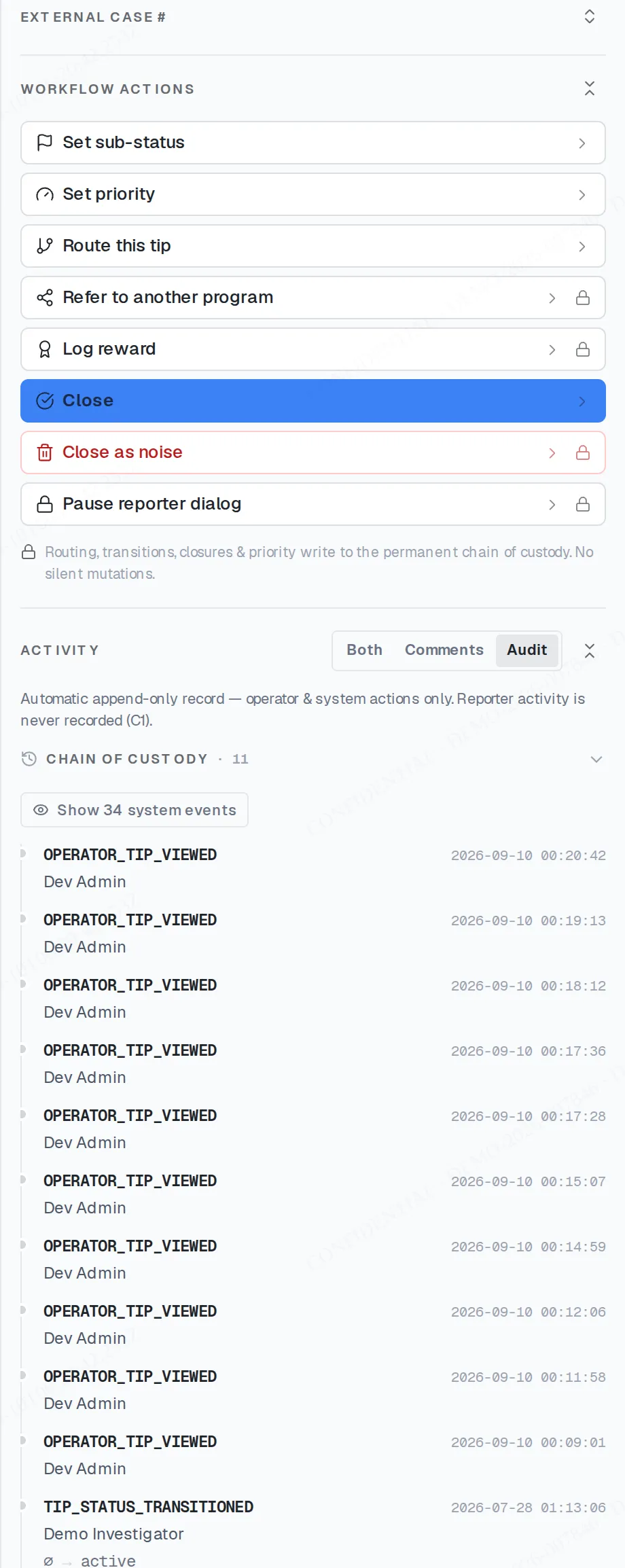
The Audit tab: who opened the tip, and when.
Why the log cannot be edited
Section titled “Why the log cannot be edited”No operator role, including the highest one in your program, can update or delete a row once it is written. That is enforced below the application, not by a screen that simply has no edit button. If a tip is ever opened by someone who should not have opened it, the record of that open still exists, unedited, for whoever reviews it later.
Related
Section titled “Related”Reporters are told about this same guarantee, in their own words, on the Operator accountability page.